PDRN benefits for skin: what to expect, honestly
PDRN is sold as a "repair" ingredient. Here is what it can realistically do in a serum or cream, and where the evidence ends.
By the MUMUKI India team · Updated 4 November 2026
In serums and creams, PDRN is used for more hydrated, plumper-looking, calmer and glowier skin. Research on injected PDRN shows support for skin repair; topical results are gentler. Any visible change usually takes 4 to 8 weeks of regular use, alongside sunscreen.
The benefits, one by one
| Benefit | What you may notice | When |
|---|---|---|
| Hydration | Skin feels less tight, looks dewier | Days to 2 weeks |
| Calmer skin | Less redness and stinging from dryness or harsh products | 1 to 3 weeks |
| Plumper look | Fine dryness lines look softer | 4 to 8 weeks |
| Glow and smoother texture | The "glass skin" look | 2 to 6 weeks |
| Firmer-looking skin | Skin looks bouncier | 8 weeks or more, modest |
These timings are typical for hydrating skincare in general, not figures from PDRN studies. Results vary by skin, product and routine. Sunscreen every morning matters more than any single ingredient.
What the research actually says
Reviews of PDRN describe it activating the adenosine A2A receptor on skin cells, supporting new blood vessel growth, collagen-making cells and calmer inflammation, mostly in wound-healing studies, many of them in the lab or in animals (Galeano et al., 2021; Naik et al., 2025). A 2025 review reports few side effects in medical studies of salmon PDRN (Park & Jang, 2025).
Most of that research uses injected PDRN. On the skin surface, large DNA fragments do not travel as deep, so serums and creams give gentler results. That is why a good PDRN product also contains proven hydrators such as hyaluronic acid, panthenol and ceramides.
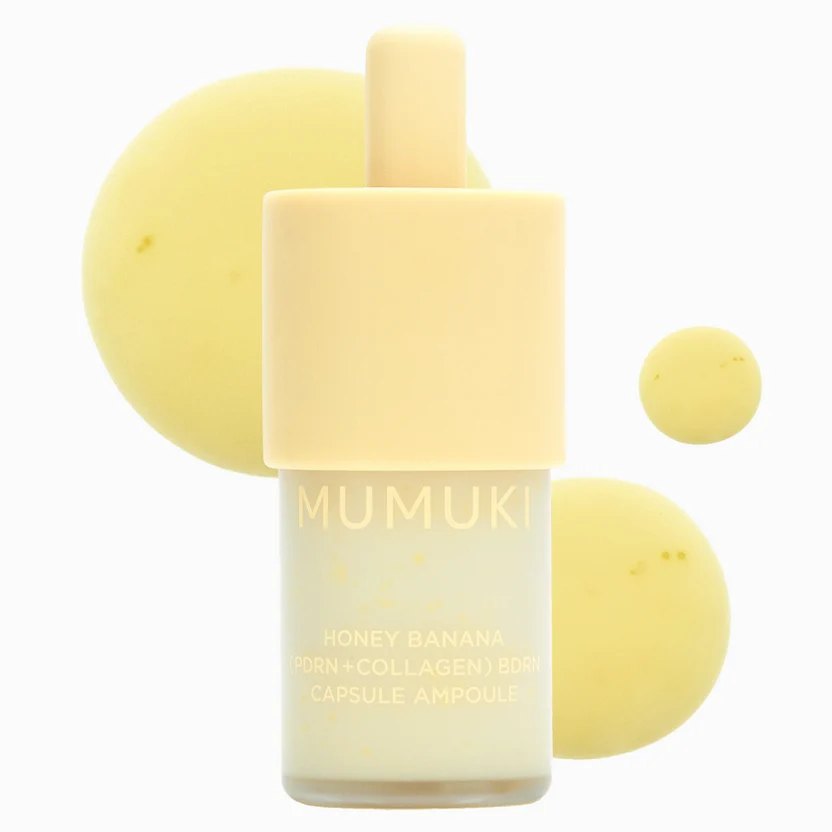
Honey Banana PDRN Capsule Ampoule
Rich, stretchy ampoule with banana PDRN & collagen that melts in with no stickiness for firm, plump, glass-glow skin.
Who benefits most
- Dry, dehydrated or tight skin, especially in AC offices and winter.
- Sensitive or easily irritated skin that cannot handle strong acids or retinol every night.
- Dull, tired-looking skin that needs bounce and glow.
- Skin recovering from sun, a harsh product or a facial (wait until any broken skin has healed).
What PDRN will not do
- It will not lighten your natural skin colour or remove melasma.
- It will not replace sunscreen, retinoids or a dermatologist's treatment for acne or pigmentation.
- It will not give injection-level results from a bottle.
Getting the most from it
- Use it on clean skin, before your moisturiser.
- Use it every day, morning or night, for at least 4 to 8 weeks.
- Pair it with hydrators (hyaluronic acid, ceramides) and daily sunscreen.
- Take photos in the same light every two weeks.
Step-by-step routines are in how to use a PDRN serum.
Frequently asked questions
Does PDRN reduce wrinkles?
It can make fine dryness lines look softer by plumping and hydrating skin. Deeper wrinkles need a dermatologist; topical PDRN gives modest changes at best.
Does PDRN help acne scars?
Research on PDRN for scars mostly uses injections or clinic procedures. A serum may help skin look smoother and calmer, but see a dermatologist for scars.
Is PDRN good for pigmentation?
PDRN is not a pigment-fading ingredient on its own. Sunscreen and ingredients like niacinamide or vitamin C do more for dark spots.
Sources
- Galeano M, et al. Polydeoxyribonucleotide: a promising biological platform to accelerate impaired skin wound healing. Pharmaceuticals (Basel). 2021;14(11):1103.
- Naik V, et al. The impact of polydeoxyribonucleotide on wound healing: a systematic review. International Surgery Journal. 2025;12(4):568-574.
- Park GY, Jang BC. Polydeoxyribonucleotide as a regenerative agent in dermatology and wound healing: mechanisms, clinical applications, and safety. Keimyung Med J. 2025;44(1). doi:10.46308/kmj.2025.00115
This guide is general skincare information, not medical advice. For skin conditions, allergies, pregnancy or injections, speak to a dermatologist.